
Prepare for your test

Listening section 1

This is the first section of your Listening test. Listen to the audio and answer questions 1-10.

Listen to the instructions for each part of this section carefully. Answer all the questions.

You can download the questions for the entire Listening practice test from the Listening practice test 1 page. The questions for section 1 are also shown on this page.

While you are listening, write your answers on the question paper. Use a pencil. 

When you have completed all four parts of the Listening test you will have ten minutes to copy your answers on to a separate answer sheet.

IELTS practice Listening test audio: section 1

First, listen to the audio. Left click on the link to listen now (the audio player will open in a new tab) or right click and select 'Save Link As' to download the file to your computer and listen later.

Questions 1-5

Example question

Answer

Destination? Harbour City


Complete the notes below.

Write no more than two words and/or a number for each answer.

Questions: transport from Bayswater

  1. Express train leaves at (1) …………………….

  2. Nearest station is (2) …………………….

  3. Number 706 bus goes to (3) …………………….

  4. Number (4) ……………………. bus goes to station

  5. Earlier bus leaves at (5) …………………….


Questions 6–10

Complete the table below.

Write no more than one word and/or a number for each answer.

Transport

Cash fare

Card fare

Bus

(6) $ …………

$1.50

Train (peak)

$10

$10

Train (off-peak)

– before 5pm or after (7) ……… pm)

$10


(8) $ …………

(9) ………… ferry 

$4.50

$3.55

Tourist ferry ((10) …………)

$35

Tourist ferry (whole day)

$65

You have completed the first section of your Listening test. Now move on to Listening section 2.
Understand Verbs, Helping Verbs, Linking verbs, Irregular Verbs &
List of Conjugation of Verbs (Three forms of Verbs)

Go to Verb List  A - BC - KL - RS - Z

Verbs are used with special rules for telling for something happens / happened /will happen - in present, in the past, or the future. Here is a list of examples for each verb tense using the verb take. You may try putting other verbs in the place of take.

Present tense ? I/you/we/they - take, he/she/it takes

Past Tense ? I/you/he/she/it/we/they - took

Future Tense - I/you/he/she/it/we/they will - take


Present Perfect Tense ? I/you/he/she/it/we/they have - broken

Past Perfect Tense ? I/you/he/she/it/we/they had - broken

Future Perfect Tense ? I/you/he/she/it/we/they will have - broken.

Helping verbs do not stand alone or express action. They are part of verb phrases that "help" the main verb. Helping verbs define the tense (past, present, future) or change the meaning of the main verb. A few examples are:

He is playing

He was playing

He may be playing

He can come

They may come

They will be smiling

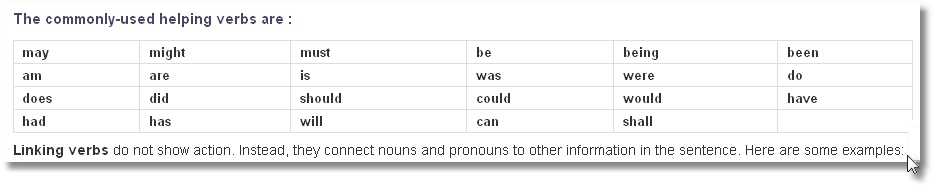
The commonly-used helping verbs are :


Conjugation of Verbs (Three forms of Verbs)

Verb conjugation refers to how a verb changes to show a different person, tense, number or mood. A

Conjugated verb is verb which has been changed to communicate one or more of the following: person, number, gender, tense, aspect, mood, or voice (active or passive voice).

Go to Verb ListA - BC - KL - RS - Z